【Editor’s Note】
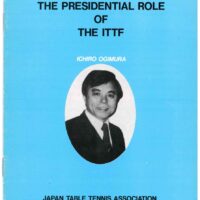
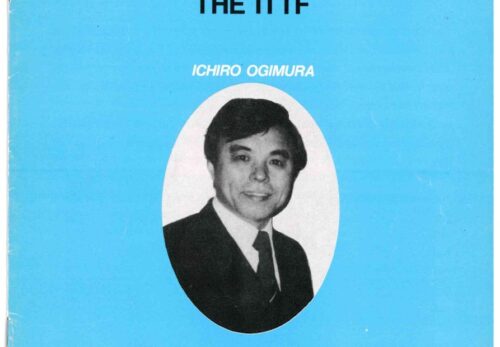
This document, titled My Thought on the Presidential Role of the ITTF, was prepared by Ichiro Ogimura in connection with his candidacy for President of the International Table Tennis Federation (ITTF) in 1987 and distributed to ITTF officials.
The document is transcribed here in its original English. Every effort has been made to preserve the original wording.
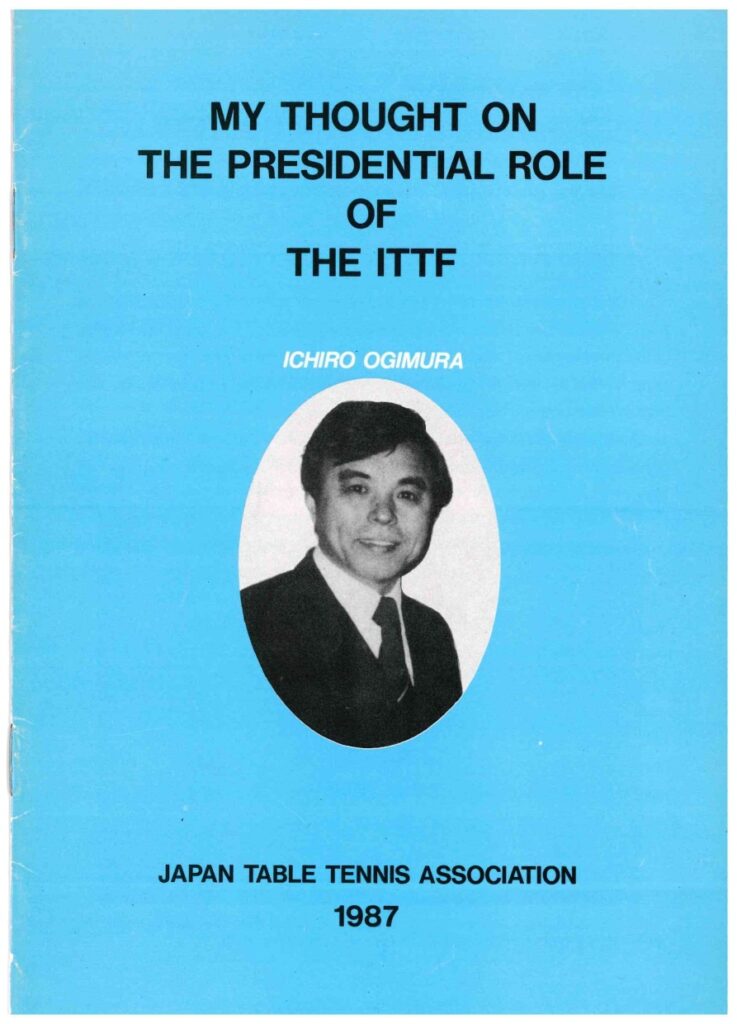
My Thought on the Presidential Role of the ITTF
Ichiro Ogimura
Timing to run for president in response to the requests
In 1983, some friends of mine requested me to run for president of the ITTF, but I turned the request down by reason of too busy own activities, thinking that what contribution I could make as president was more important, if I run for president at all, than whether I could win or not.
Also, I had laid my hopes on president Mr. Evans.
In 1985, a fairly large number of my friends encouraged me to run for president again, but I declined as before, and I supported reelection of Mr. Evans on condition that he will direct all the members impartially so friendly relations will be maintained among them.
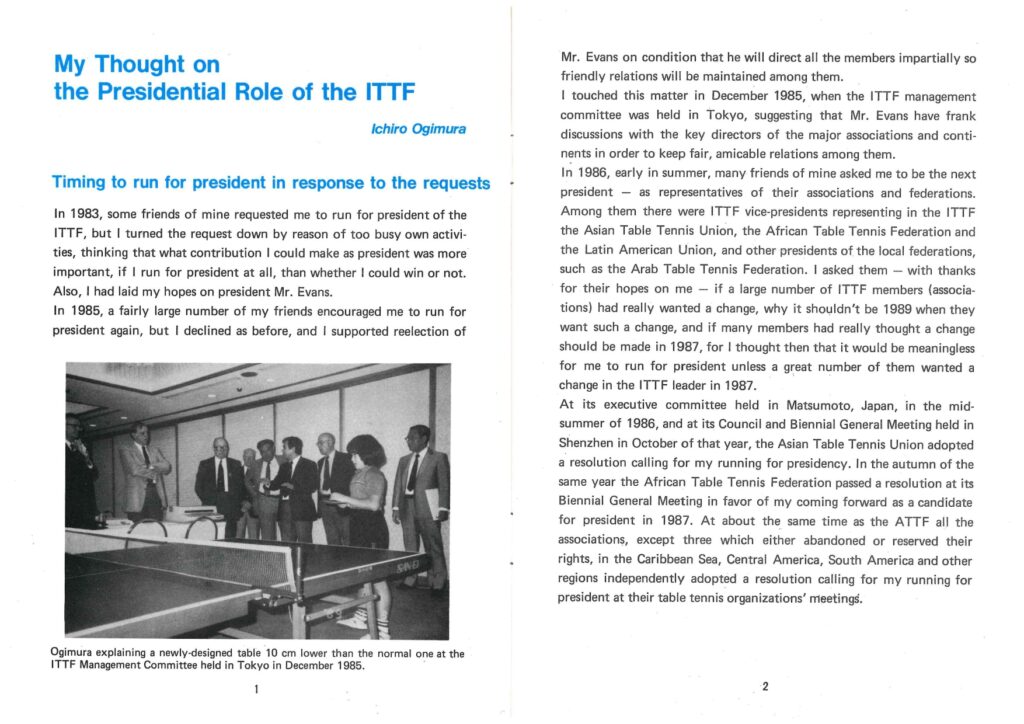
I touched this matter in December 1985, when the ITTF management committee was held in Tokyo, suggesting that Mr. Evans have frank discussions with the key directors of the major associations and continents in order to keep fair, amicable relations among them.
In 1986, early in summer, many friends of mine asked me to be the next president — as representatives of their associations and federations.
Among them there were ITTF vice-presidents representing in the ITTF the Asian Table Tennis Union, the African Table Tennis Federation and the Latin American Union, and other presidents of the local federations, such as the Arab Table Tennis Federation.
I asked them — with thanks for their hopes on me — if a large number of ITTF members (associations) had really wanted a change, why it shouldn’t be 1989 when they want such a change, and if many members had really thought a change should be made in 1987, for I thought then that it would be meaningless for me to run for president unless a great number of them wanted a change in the ITTF leader in 1987.
At its executive committee held in Matsumoto, Japan, in the mid-summer of 1986, and at its Council and Biennial General Meeting held in Shenzhen in October of that year, the Asian Table Tennis Union adopted a resolution calling for my running for presidency.
In the autumn of the same year the African Table Tennis Federation passed a resolution at its Biennial General Meeting in favor of my coming forward as a candidate for president in 1987.
At about the same time as the ATTF all the associations, except three which either abandoned or reserved their rights, in the Caribbean Sea, Central America, South America and other regions independently adopted a resolution calling for my running for president at their table tennis organizations’ meetings.
My thought about presidency
In December 1986, the leaders of the table tennis organizations in Asia, Africa, Arab, Latin America, etc. explained the situations to the leaders of the European Table Tennis Federations, one of the key components of the ITTF, to deepen their understanding.
They all pointed out that a change had been sought after in Europe as well, but said most of their federations were for a change in 1989, while some were in favor of a change in 1987.
At individual meetings with the presidents of the Continental Federations — Asian, African, Latin American and European — and at the meeting of the Asian and European Table Tennis Union Mr. Xu Yinsheng, President of the China Table Tennis Association and Vice-President representing Asian Continent of the ITTF, told Mr. Kapetanic, President of the European Table Tennis Federation, and other leaders there that more than 80 of some 120 associations having the right to vote the ITTF President had wanted a change in presidency in 1987, and that he believed they wanted me to assume the next presidency.
At the meeting I expressed my thought as follows:
- It is important to identify if a large number of members of ITTF want a change in 1987. If identified, then who should be the leader is a matter of consequence. Presidency of the ITTF should be based not on the concept that someone runs for it because he wants to be President, but on the concept that someone runs for it taking into account the situation as he was nominated. Therefore, I have never written a letter, or given a telephone call, asking for support until that time to any person.
- If a great number of them want a change in 1987, and if they want me to be President, then I am confident that I can do the best job and contribute to the prosperity of the ITTF and to the world-wide expansion of table tennis. I believe it is the best choice to use me as President.
- On September 27, 1986, the Japan Table Tennis Association accepted at its board of directors the request for Ogimura’s running for President, which was resolved by the executive committee of the Asian Tennis Union. However, a final decision will be made when it is reconfirmed first-hand that a large majority not only in Asia but also in other parts of the world want me to run for presidency, according to my suggestion.
- I know very well that Mr. Evans has long been making efforts for the growth of the ITTF, and that he has made great contributions in the past. Also, I have heard direct from him that Mr. Evans hopes to watch in his capacity as president table tennis players enter and parade at the Olympic stadium when the opening ceremony is held in 1988. However, the presidency of the ITTF shouldn’t be a bonus for past contributions. Also, the ITTF can cope with such sentiment and emotion of Mr. Evans by separating them from his presidency. In fact, the Japan Table Tennis Association made a proposal for dealing with this issue at its Biennial General Meeting held in 1987 already.
- I am competent for presidency because I am in a position to contribute most to the expansion of table tennis. Firstly, the table tennis circles in Japan and the Japan Table Tennis Association are one of the most powerful organizations among theinternational table tennis world for the exchange with other associations, infrastructure and rich experience of domestic administration.Personally, I have a long experience as a player and know the skill of table tennis very well. Since I have coaching experience not only in Japan but also in Europe and other continents, I am well informed about other continents and other associations. In addition, I have concerned myself as managing director for the Japan Table Tennis Association in building up the organization for seven years on voluntary status, and the JTTA — of all sports associations in Japan — has a powerful infrastructure, which has been evident by the fact that 2nd Asian and European Tournament last December were staged successfully in thirteen cities of Japan last September.If I were elected President, then I would be able to keep perfect relations with, and give a fair deal to, any associations of the world. Since I am still young, I would, if elected President, visit some 80 countries within a year to talk over problems facing some associations there for the growth of table tennis. And I would report on their situations before the ITTF officers, and would suggest some new plans for their prosperity.
- The ITTF President is in a position to do a lot of work; therefore, I would have to retire from the post of managing director for the JTTA, which its board of directors have already agreed to. Personally, I intend to retire from the presidency of the company I manage now to devote my time to the new office.
- Even if I ever assume the ITTF presidency, I wouldn’t give too much importance to Asia or China, and wouldn’t be a mouthpiece for China, either. Friends of mine in Asia said openly that they would not demand that, and the China Table Tennis Association said definitely that they would demand just a fair deal. I would, of course, do so, and think the ITTF President must be fair and amicable to all the member associations.
- Considering the current international situation and the environment surrounding table tennis, I believe it is the most advantageous for table tennis to compete with other sports and recreational sports to use me, a Japanese, as president, because I can contact and communicate usefully and easily with people in every field and sector as well as the ITTF Secretariat and the Continental Federations.
My thought on the election of President
At the election of President in coming February I believe it is the best way to avoid election (competition) by judging and respecting the consensus.
If it is true that a great majority want a change, then I hope that Mr. Evans will determine to assume an honorable position as one of responsible leaders and to contribute in that capacity to the Olympic Games and other events. It is a leader’s responsibility to act on consensus. The same attitude shall have to be applied to my action.
My thought about the ITTF policy
1. Competitive power must first be strengthened.
Competition with other sports has become increasingly keen. New sports have begun to eat into the field of table tennis. To table tennis, the participation in the Olympic Games is a monumental change, but to 20-odd other events, it is just a matter of course. Unless we develop
and push on with new plans aggressively without just eyeing the Olympics, table tennis might follow a course of ruin.
2. Realize balance of power by encouragement policy.
It is not advisable for a certain association to continue winning titles.
This discourages others. However, I would not agree to the thought, “Make it weak. That will do.” I would say, “So, make weak associations stronger.” The way they get strong varies with the situations they are put in.
If more associations adopt an encouraging policy by the assistance of ITTF to compare with and defeat China, then the balance of power will be realized at a higher level and table tennis will increase its power to compete with other sports.
Balance of power realized by a policy discouraging those making efforts will invite a lowering of the level, which will eventually impoverish table tennis.
3. Toward a multipurpose event federation.
The ITTF stages the World Championships, the World Cup and other tournaments among top players, but we should popularize and expand table tennis in a variety of forms among many different classes without just staging those prestigious events.
In this respect, the experience of the JTTA as a foregoer will make an invaluable asset.
In Japan, we have twelve championships by age between 8 to 80-year-olds, open tournaments based not only on the international rule but on the softball rule, and hold many other meets by occupation and trade, in-house events, etc. in addition to those among the Sports Boy Scouts, clubs, elementary school-children, junior and senior high school students, undergraduates, company employees, women, veterans, physically handicapped persons, etc. Also, in Japan, the rule for older players is under study in collaboration with medical experts, and some events for beginners on a handicap basis are blueprinted.
Moreover, a round table, lower table, a large ball, and a lighter ball have been made by way of trial, and some of them are already on the market.
The ITTF should develop and implement plans for furthering the world-popular table tennis by virtue of the know-how the JTTA and other associations are equipped with through their foregoing experiences.
4. No dictatorship, more conference.
The ITTF should avoid arbitrary decision and execution by discussing matters of consequence in advance with the representatives of the continental and local federations through the use of the advanced communication systems.
In Japan, for example, the JTTA holds the board of directors four times a year, the board of councils twice a year, the board of managing directors twelve times a year, and the Planning Coordination Committee ten times a year. And the minutes of these over 30 conferences are sent biweekly to the leaders, which number 350, of main circles’ opinion leaders for close communication and report.
Since this action of the JTTA’s acquaints the persons concerned with a lot of proposals before these are submitted to a conference for deliberation, they are managed smoothly with the least trouble and new projects are implemented steadily.
As a result, the appropriation budget has tripled in the last six years after Ogimura’s appointment as managing director, to some US$2 million, which is at a top level among all sports organisations in Japan.
In order to realize this great leap, JTTA did not increase fees from manufacturers, Government is paying 2.5 percent only.
Personal History
Name: ICHIRO OGIMURA
Born: 1932 between Christian father and Buddhist mother
Education: Graduate of Nihon University
Playing Career:
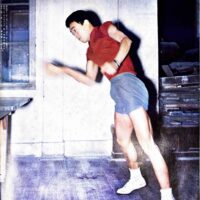
Started to play Table Tennis at the age of 16 in 1948.
Became World Champion in 1954 at Wembley.
World Title 12
Asian Title 8
National Title 11
Coaching Career:
Sweden, China, USA, South Korea, Brazil, West Germany, Saudi Arabia, Egypt, etc. (Stayed over 20 countries for coaching) and Japan
T.T. and Sports Official career:
- (Hon.) General Director of JTTA since 1980
2. Japan Olympic Committee since 1984
3. Councilor of the Japan Sports Federation
4. National Hon. Sports Instructor for Ministry of Education, science and culture
5. Member of Sports Interchange Conference for Ministry of Foreign Affairs
6. International Table Tennis Federation council and then Deputy President since 1970s
7.Executive committee of Asian Table Tennis Union
8.Advisor to World Boys Nankyu Baseball Federation
9.Director of the Board of World Gate Ball Federation
Business:
1. Owner of Kokusai Building
(Supermarket, Table-Tennis and Fitness Centre, and Rental Flats: now under reconstruction and opening in Feb. 1987)
2. President of Ogimura Shoji Company
(Iron & steel, Machinery, Automobile, Petro-chemicals, Silk, Carpets, Foods, Crafts, Stationeries, Household items)
3. Advisor to Hexatrade of Sweden
(A leading trading company in Sweden which has over 40 groups of companies under its umbrella. Represents Fuji Film, Nippon Kokan, Matsushita in Scandinavia.)
Japanese Translation(日本語訳はこちら)